As a freight broker I have learned the various types of trucks used to move various types of products. Trucks carry 94% of all furniture, fixtures and appliances for the American home. Look around your house, most of the stuff in there was moved by a truck or several trucks before it reached your home.
Here are some of the kinds of trucks used to move cargo:
Refrigerated semitrailers (or reefers)
Ragtops (canvas-covered, boxlike trailers)
Dry vans (nonrefrigerated semitrailers)
Liquid tankers (trailers designed to carry liquid or fine bulk materials
Containers (shipping containers used for freight carried on ships or trains)
Air-ride (trailers built to reduce road shock and designed to carry fragile items)
Freight brokers often specialize in a certain type of cargo which will often require a certain type of truck. One of our graduates focus is cars. Cars are moved on transporters. This freight broker has learned the carriers that drive transporters. She also has built a relationship with car dealers, auctions and manufacturers that need their cars moved.
The world of transportation is quite fascinating. Enjoy learning all you can about trucks, various cargo loads and what is required to handle each.
Moving forward,
Jeff Roach
www.transportationtraining.com


Startup Business Failure Rate By Industry
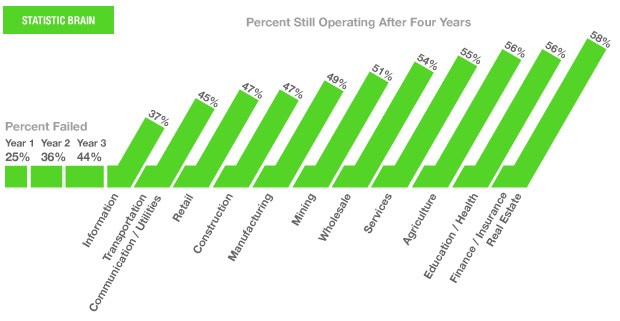
| Industry | Percent Still Operating After 4 Years |
| Finance Insurance and Real Estate | 58 % |
| Education and Health | 56 % |
| Agriculture | 56 % |
| Services | 55 % |
| Wholesale | 54 % |
| Mining | 51 % |
| Manufacturing | 49 % |
| Construction | 47 % |
| Retail | 47 % |
| Transportation, Communication and Utilities | 45 % |
| Information | 37 % |
| Year | Percent Failed |
| Year 1 | 25 % |
| Year 2 | 36 % |
| Year 3 | 44 % |
| Year 4 | 50 % |
| Year 5 | 55 % |
| Year 6 | 60 % |
| Year 7 | 63 % |
| Year 8 | 66 % |
| Year 9 | 69 % |
| Year 10 | 71 % |
| Major Cause | Percentage of Failures | Specific Pitfalls | |
| 1 | Incompetence |
46 %
|
Emotional Pricing |
| Living too high for the business | |||
| Nonpayment of taxes | |||
| No knowledge of pricing | |||
| Lack of planning | |||
| No knowledge of financing | |||
| No experience in record-keeping | |||
| 2 | Unbalanced Experience or Lack of Managerial Experience |
30 %
|
Poor credit granting practices |
| Expansion too rapid | |||
| Inadequate borrowing practices | |||
| 3 | Lack of Experiences in line of goods or services |
11 %
|
Carry inadequate inventory |
| No knowledge of suppliers | |||
| Wasted advertising budget | |||
| 5 | Neglect, fraud, disaster |
1 %
|
| Leading Management Mistakes | |
| 1 | Going into business for the wrong reasons |
| 2 | Advice from family and friends |
| 3 | Being in the wrong place at the wrong time |
| 4 | Entrepreneur gets worn-out and/or underestimated the time requirements |
| 5 | Family pressure on time and money commitments |
| 6 | Pride |
| 7 | Lack of market awareness |
| 8 | The entrepreneure falls in love with the product/business |
| 9 | Lack of financial responsibility and awareness |
| 10 | Lack of a clear focus |
| 11 | Too much money |
| 12 | Optimistic/Realistic/Pessimistic |

